A Guide to Common Bolt and Nut Varieties
Nuts and bolts are staples of construction work, and they are available in numerous designs tailored to specific purposes. This overview covers several frequently used bolt styles as well as a few common nut types.
By Taylor Cooper
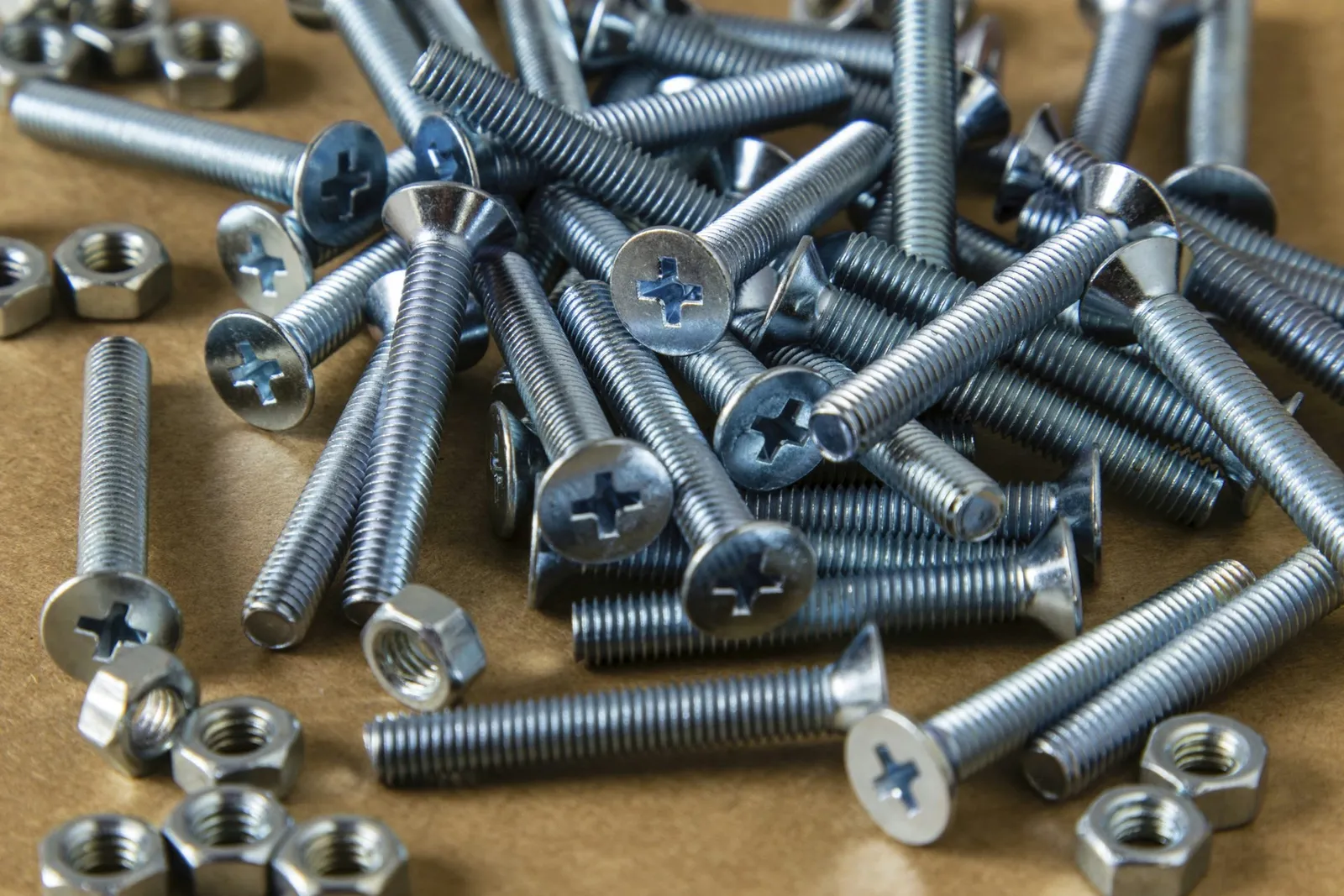
A close-up of assorted nuts and bolts.
The phrase "nuts and bolts" often refers to the fundamental or practical elements of a subject. In the physical world, nuts and bolts genuinely act as core pieces in countless building projects. Though they appear routinely in the supplies of anyone doing construction, both nuts and bolts are manufactured in many different designs, and each design is intended for a specific job.
Hex Bolts
Hex bolts are recognizable by their six-sided, or "hex," heads. The shaft of a hex bolt might be threaded along its entire length up to the head, or it might have threading on only part of it. A hex bolt can be paired with a nut or used in a tapped hole. The abbreviations HHMB and HXBT are sometimes used to refer to hex bolts.
Hanger Bolts
A hanger bolt stands apart from other bolt types because it does not follow the standard head-and-shaft structure. Instead, a hanger consists of one shaft that carries different threading at each end. It is used to join a wood component, which takes wood threading on one end, to another component that accepts a machine thread.
Carriage Bolts
The carriage bolt is distinguished by its head, which is rounded and has no slot for a screwdriver. Right under the smooth head, a carriage bolt features a square section before narrowing into a partially threaded shaft. Like most bolts, a carriage bolt has a flat end, with the lag bolt being the exception.
Chicago Bolts
Chicago bolts, barrel nuts, and sex bolts are three names for the same distinctively shaped bolt. Most bolts have threading on the exterior of a cylindrical shaft, but the Chicago bolt differs: its shaft is hollow, smooth on the outside, and threaded on the inside. This internal threading is also called a "female" thread. Chicago bolts join with ordinary ("male") bolts in the same manner as standard nuts. Still, because they have both a head and a shaft, they are often categorized as bolts.
Hex Nut Types
A standard hex nut has six sides and is also known as a "finished hex nut." Since it is the most widely used nut type, a number of variants are available. A nylon insert lock, or nylock, is a hex nut containing a nylon insert that helps keep it firmly in position. A jam nut is a hex nut of shorter height. A nylon insert jam lock is, by extension, a shorter version of a nylock.
Wing Nuts
Wing nuts are commonly chosen for craft work and other short-term fastening. Their heads are formed into two "wings" that are simple to pinch between thumb and forefinger, so the wing nut can be tightened by hand.
Cap and Acorn Nuts
A cap nut is sealed at one end and has a smoothly domed top. It is best suited to uses where only a small portion of the bolt is visible, or where the cap nut does not need to be turned all the way down the bolt's shaft. An acorn nut shares roughly the same structure as a cap nut, except that its rounded end features a taller crown.